
Latest Top LGA 1156 platform combo -GIGABYTE P55-UD6 with Intel Core i7-870
-
LGA 1156socket is Intel main product in 2nd half 2009.
The core technology is same as hi-end product LGA1366 which launched last year and make minor modification.
It will replace current mid-high product line.
Currently, LGA 1156 Chipset is P55, is Intel single chipset MB.
Some MCH functions are built in CPU. This is the key difference between P55 and X58.
Also, X58 is triple channel and QPI design. P55 is dual channel design.
Not hard to see that all MB manufacturers has announced their P55 products.
Same as hi-end X58, P55 also separate into hi-end, mid-end and entry price level.
This is GIGABYTE most hi-end one. The model name is P55-UD6.
Product package is big color box. It’s also the usual size for hi-end product.

GIGABYTE P55-UD6 Body

Ultra Durable3 is the key feature

Now the first launch LGA1156 CPU are i5-750, i7-850 and i7-870 3 models. The i7 support HT technology.
This article is retail version LGA 1156, the most hi-end one, Intel Core i7-870, clock 2.93GHz, L3 8MB.

Intel quad core CPU all bundle with copper bottom Cooler.
However, for i7 with HT, the original cooler cannot suffer for OC.

Back to GIGABYTE P55-UD6 detail
Lower left corner
3 X PCI-E (X16?X8?X4), support CrossFire and SLI Technology at X8+X8
2 X PCI-E X1
2 X PCI
Realtek 8111D dual LAN ships support Teaming
Realtek ALC889A supports 7.1 channel and High Definition Audio/Dolby Home Theater technology.
PCB is MADE IN TAIWAN

Lower right corner
6 X blue SATAII, support RAID 0, RAID 1, RAID 5 and RAID 10
2 X white SATAII, support RAID 0, RAID 1 and JBOD
1 X IDE
Dual BIOS means dual protection. SB position is GIGABYTE SA and JMB362TA2 chip.
Blue button is Reset, black one is Clear CMOS and also built-in Debug LED.

Upper right corner
6 X DIMM DDR3 support 800/1066/1333/1600. The highest DDR3 capacity is 16GB.
Not same as the others P55 with 4 DIMM. UD6 is 6 DIMM slots and provide more expansion capability.
DDR3 has 2 phase PWM and next by is 24-PIN power in.

Upper left corner
LGA 1156 CPU Socket
UD6 use 24 phase PWM which is the most hi-end spec in the market now.
For phase numbers, there are many discussions in the internet. Some think it’s good and some don’t.
I think if the energy saving design is good, and change phases by utility rate. More phase design is good.

IO
8 X USB 2.0
2 X RJ-45 LAN
2 X eSATA/USB 2.0 combo
1 X S/PDIF fiber/coaxial output
1 X 1394a

-
LGA 1156socket is Intel main product in 2nd half 2009.
The core technology is same as hi-end product LGA1366 which launched last year and make minor modification.
It will replace current mid-high product line.
Currently, LGA 1156 Chipset is P55, is Intel single chipset MB.
Some MCH functions are built in CPU. This is the key difference between P55 and X58.
Also, X58 is triple channel and QPI design. P55 is dual channel design.
Not hard to see that all MB manufacturers has announced their P55 products.
Same as hi-end X58, P55 also separate into hi-end, mid-end and entry price level.
This is GIGABYTE most hi-end one. The model name is P55-UD6.
Product package is big color box. It’s also the usual size for hi-end product.
GIGABYTE P55-UD6 Body
Ultra Durable3 is the key feature
Now the first launch LGA1156 CPU are i5-750, i7-850 and i7-870 3 models. The i7 support HT technology.
This article is retail version LGA 1156, the most hi-end one, Intel Core i7-870, clock 2.93GHz, L3 8MB.
Intel quad core CPU all bundle with copper bottom Cooler.
However, for i7 with HT, the original cooler cannot suffer for OC.
Back to GIGABYTE P55-UD6 detail
Lower left corner
3 X PCI-E (X16?X8?X4), support CrossFire and SLI Technology at X8+X8
2 X PCI-E X1
2 X PCI
Realtek 8111D dual LAN ships support Teaming
Realtek ALC889A supports 7.1 channel and High Definition Audio/Dolby Home Theater technology.
PCB is MADE IN TAIWAN
Lower right corner
6 X blue SATAII, support RAID 0, RAID 1, RAID 5 and RAID 10
2 X white SATAII, support RAID 0, RAID 1 and JBOD
1 X IDE
Dual BIOS means dual protection. SB position is GIGABYTE SA and JMB362TA2 chip.
Blue button is Reset, black one is Clear CMOS and also built-in Debug LED.
Upper right corner
6 X DIMM DDR3 support 800/1066/1333/1600. The highest DDR3 capacity is 16GB.
Not same as the others P55 with 4 DIMM. UD6 is 6 DIMM slots and provide more expansion capability.
DDR3 has 2 phase PWM and next by is 24-PIN power in.
Upper left corner
LGA 1156 CPU Socket
UD6 use 24 phase PWM which is the most hi-end spec in the market now.
For phase numbers, there are many discussions in the internet. Some think it’s good and some don’t.
I think if the energy saving design is good, and change phases by utility rate. More phase design is good.
IO
8 X USB 2.0
2 X RJ-45 LAN
2 X eSATA/USB 2.0 combo
1 X S/PDIF fiber/coaxial output
1 X 1394a
-
Close to look at UD6 24 phase PWM components

Heat pipe design for PWM

P55 NB heat-pipe design
P55 is single chip design. Besides CPU built-in memory controller, it also take in charge of PCI-E X16/X8 bridge.

SB heat sink

24 phase PWM components in PCB back

Due to new CPU built in memory controller, as you install DDR3, normal design is installing from the 2nd set DIMM.
UD6 is special. You need to install from white DIMM slots.

Boot up screen

Main adjustment menu

CPU frequency, ratio and other setup

CPU related technology items

-
Memory setup menu
There are 4 ratios. If not OC and select 12.0, it operates as 133/1600.

Voltage page
Load-Line Calibration StandardLevel1/Level2
CPU Vcore 0.50000~1.90000V
QPI/Vtt Voltage 0.800~1.940V
PCH Core 0.850~2.080V
CPU PLL 1.500~2.580V
DRAM Voltage 1.300~2.600V

This function can enable SAMRT TPM

PC Health Status

UD6 is hi-end product. The voltage items and range in BIOS are rich.
The setup above is I run stable at 200/2000. If you have good quality or similar hardware, you can refer to the setup.
Test configuration
CPU: Intel Core i7-870
MB: GIGABYTE P55-UD6
DRAM: CORSAIR Dominator 2GBX2 DDR3 1866C9D
VGA: MSI R4890 CYCLONE DDR5 1GB CrossFireX
HD: CORSAIR CMFSSD-64GB2D (RAID 0)
POWER: Antec TruePower New TP-750
Cooler: Intel Cooler

GIGABYTE latest OS software - Smart6
SMART QuickBoot, SMART QuickBoost, SMART Recovery, SMART Dual BIOS,SMART Recorder and SMART TimeLock.

QuickBoot has BIOS and OS.

Default setup has 3 OC modes to enhance system perfoemance.

Recovery page

Set up computer utility time. Normally use to control kids at home.

-
Smart TPM is the other new software. User can use Bluetooth to enable or disable the PSD drive.

GIGABYTE this time except puts lots efforts in hardware components and BIOS but also software.
GIGABYTE provides more software with P55 to make users have more convenient features.
Performance test
CPU default clock 133 X 22=> 2931MHz
DRAM DDR3 1600 CL8 8-8-24 1T
Turbo Boost Tech disable
Hyper 8 X PI 32M=> 19m 35.946s
CPUMARK 99=> 455

CrystalMark 2004R3

CINEBENCH R10
1 CPU=> 4142
x CPU=> 17087

PCMark Vantage=> 13679

DDR3 1600 CL8 8-8-24 1T
Sandra Memory Bandwidth-19571MB/s
EVEREST Memory Read-14583MB/s

MSI 4890 CorssFireX
3DMARK VANTAGE 18278

Enable HT in i7-870 2.93GHz to simulate 8 core performance is also the highest performance in LGA 1156.
LGA 1156 DDR3 dual channel performance is also 30% higher than LGA 775. It all attribute to CPU built in memory controller.
OC Test
CPU default clock 200 X 20=> 4000MHz
DRAM DDR3 2000 CL9 9-9-24 1T 1.66V
CPU Multi-Threading disable
Hyper 4 X PI 32M=> 9m 52.739s
CPUMARK 99=> 622

CrystalMark 2004R3

CINEBENCH R10
1 CPU=> 5710
x CPU=> 20483

-
PCMark Vantage=> 14892

DDR3 2000 CL9 9-9-24 1T
Sandra Memory Bandwidth-24962MB/s
EVEREST Memory Read-18665MB/s

MSI 4890 CorssFireX
3DMARK VANTAGE 20068

Currently there is only original cooler, when OC to 4GHz, the CPU temperature is too high.
So you have to disable HT to run at 4GHz. As I get other hi-end cooler, I will do more test again.
200/2000 stable frequency doesn’t need too much setup. Voltage is also not high. As the experience, P55 OC ability is close to X58.
Finally, pull up CPU/DDR3 clock
CPU 188 X 22=> 4136MHz
Hyper 4 X PI 1M=> 10.608s
CPUMARK 99=> 642

DDR3 2256 CL9 9-9-24 1T
Sandra Memory Bandwidth-26890MB/s
EVEREST Memory Read-19789MB/s

It can reach above 4.1GHz with original Cooler. The CPU OC range is good.
But the original cooler is not good enough, when it’s over 3.8G, the temperature could be over 90 degree.
Due to DDR3 only run at dual channel, DDR3 clock can pull up easier than triple channel i7.
GIGABYTE GA-P55-UD6
Good
1.GIGABYTE hi-end P55 products has high quality package and components.
2.24 phase PWM with DES energy saving technology. It makes PWM efficiency be better.
3.2oz PCB, All Japanese solid capacitors, Debug LED and built in Power/Reset//Clear CMOS buttons
4.P55 supports ATI CrossFireX and Nvidia SLI simultaneously.
5.Rich BIOS items, Wide voltage range and good OC ability in CPU/DDR3
6.Built in 10 SATAII, IO expansion capability is high, 8 USB and 2 USB/eSATA combo ports.
Weakness
1. P55-UD6 price is too high for normal users.
2. As new structure, CPU categories are less. There’s only i7-860 and i5-750 have higher C/P.

Performance ??????????
Components ??????????
Specification ??????????
Outlook ??????????
C/P Value ??????????
As for first stage of LGA 1156 focus on mid-hi end, LGA 1336 CPU+MB price compare to LGA 1156 CPU+MB are not much.
Only if you use i5-750 without HT, these 2 platforms price gap will be 100~150USD.
Otherwise, current P55 boards in the market are around 5000~9000NTD which is 150~275USD.
By contrast, X58 boards are launched around 10 months and the price is around 6500~10000NTD which is 200~300USD.
In MB price, new P55 boards are positioning on more hi-end and the market will have more lower price P55 boards in the future.
During that time, the price gap between 2 platforms will be bigger.
For CPU, LGA 1156 will have more variety i5/i7 CPU, even entry i3 or dual core i7 CPU to support LGA 1156 will make this platform be more affordable.
GIGABYTE will also have over 10 models as naming UD3/UD4/UD6 P55 MB.
Now LGA 1156 platform starts from mid-high market and there are more PCU and vary boards in the market.
We are looking forward LGA 1156 structure platform moving to mainstream market to make users have more choice in affordable price.

-
Very good GIGABYTE P55-UD6!

-
Fantastic mobo
thanks windwithme 
-
Excellent Tests Windwithme !!
cpu and mobo are awesome..
-
4 GHz stock cooling

-
Another very good job, windwithme :clapclap:
Confermando che la mobo sembra davvero ben sviluppata e costruita, occorre anche passare alle valutazioni critiche sul lavoro di GigaByte.
Sarà, e forse potrò sbagliarmi, ma assolutamente non capisco il posizionamento di questa scheda che costerà decisamente non poco, e comunque al pari di molte valide soluzioni X58.
Non comprendo il perchè di ben 24 fasi su una piattaforma non-top, così come non capisco le motivazioni che hanno portato all'utilizzo di 6 slot di memoria quando P55 gestisce in realtà solo il Dual Channel :cheazz:
Avendo bene a mente le problematiche aggiuntive del ctrl di memoria nel gestire già una seconda coppia di segnali, figuriamoci con la terza

Non vedo per niente bene tutti quei mosfet utilizzati nel lato inferiore del pcb: sembrano decisamente troppi!!
A funzionare ovviamente funzionano e anche bene: ma a medio-lungo termine il persistente calore superficiale in quell'area, che riceve ben poco flusso d'aria diretto, potrebbe verosimilmente provocare delle problematiche.
Altrimenti che senso avrebbe il dissi posizionato sul lato superiore del pcb per il raffreddamento degli analoghi fratelli più fortunati? :cheazz:
Alla fine, tra qualche mese questa mobo potrà divenire senz'altro un must, ma attualmente me ne sfuggono gran parte delle motivazioni
@Le085
sebbene d'accordo che 4.0Ghz@stock sia un risultato decisamente appetitoso (+33%), è stato ottenuto con l'HT disattivato, e le temp comunque prossime ai 95°C, quindi molto lontane da un ottenimento stabile in daily.
Imho, un analogo paragone con i risultati di X58 potrebbe rivelarsi fuorviante: lavorando il ctrl di memoria in solo Dual Channel, favorisce una stabilità operativa decisamente superiore al corrispettivo X58 con Tri-Channel attivato.
Infatti, anche con X58 lavorando con soli 2 moduli si riescono ad ottenere risultati in frequenza stabili, ben più importanti che con Tri-Channel attivato
In definitiva, se la mobo viene a costare praticamente la stessa cifra, e la cpu solo poco meno, ha senso optare per una soluzione di questo tipo, rispetto a 920 + X58 di fascia media/medio-alta?
-
indubbiamente ha ragione...la tua valutazione è stata molto precisa ed accurata......ancora non riesco a capire che azioni stanno facendo alla intel ed relative case produttrici di mobo......
-
mi piacerebbe avere un riscontro prestazionale tra questa soluzione e una sorella gigabyte x58 più 920......
Se le prestazioni non dovessero distanziarsi ragionevolmente, penso che potrei orientarmi per una soluzione simile a quella testata da windwithme, con un conseguente (e piacevole) risparmio in termini economici

-
Totocellux ha scritto:
Another very good job, windwithme :clapclap:Confermando che la mobo sembra davvero ben sviluppata e costruita, occorre anche passare alle valutazioni critiche sul lavoro di GigaByte.
Sarà, e forse potrò sbagliarmi, ma assolutamente non capisco il posizionamento di questa scheda che costerà decisamente non poco, e comunque al pari di molte valide soluzioni X58.
Non comprendo il perchè di ben 24 fasi su una piattaforma non-top, così come non capisco le motivazioni che hanno portato all'utilizzo di 6 slot di memoria quando P55 gestisce in realtà solo il Dual Channel :cheazz:
Avendo bene a mente le problematiche aggiuntive del ctrl di memoria nel gestire già una seconda coppia di segnali, figuriamoci con la terza
Non vedo per niente bene tutti quei mosfet utilizzati nel lato inferiore del pcb: sembrano decisamente troppi!!
A funzionare ovviamente funzionano e anche bene: ma a medio-lungo termine il persistente calore superficiale in quell'area, che riceve ben poco flusso d'aria diretto, potrebbe verosimilmente provocare delle problematiche.
Altrimenti che senso avrebbe il dissi posizionato sul lato superiore del pcb per il raffreddamento degli analoghi fratelli più fortunati? :cheazz:
Alla fine, tra qualche mese questa mobo potrà divenire senz'altro un must, ma attualmente me ne sfuggono gran parte delle motivazioni
@Le085
sebbene d'accordo che 4.0Ghz@stock sia un risultato decisamente appetitoso (+33%), è stato ottenuto con l'HT disattivato, e le temp comunque prossime ai 95°C, quindi molto lontane da un ottenimento stabile in daily.
Imho, un analogo paragone con i risultati di X58 potrebbe rivelarsi fuorviante: lavorando il ctrl di memoria in solo Dual Channel, favorisce una stabilità operativa decisamente superiore al corrispettivo X58 con Tri-Channel attivato.
Infatti, anche con X58 lavorando con soli 2 moduli si riescono ad ottenere risultati in frequenza stabili, ben più importanti che con Tri-Channel attivato
In definitiva, se la mobo viene a costare praticamente la stessa cifra, e la cpu solo poco meno, ha senso optare per una soluzione di questo tipo, rispetto a 920 + X58 di fascia media/medio-alta?
La risposta è decisamente no.....non ha senso spendere soldi se la differenza di prezzo tra un sistema Intel Core i5 e un sistema Inlel Core i7 920 è bassa.
Secondo me, Intel punta ha dividere il mercato in due....mi spiego meglio.
Le soluzioni TOp saranno con il nuovo processore Core i9 + scheda madre X58.
La fascia media invece sarà con Intel Core i5 e scheda madre P55. I core i7 920 sono destinati a scomparire e si partirà solo dalla prosuzione di Core i7 950 in su.
La facia bassa con X48 e Q9xxx
-
dj883u2 ha scritto:
La risposta è decisamente no.....non ha senso spendere soldi se la differenza di prezzo tra un sistema Intel Core i5 e un sistema Inlel Core i7 920 è bassa.Secondo me, Intel punta ha dividere il mercato in due....mi spiego meglio.
Le soluzioni TOp saranno con il nuovo processore Core i9 + scheda madre X58.
La fascia media invece sarà con Intel Core i5 e scheda madre P55. I core i7 920 sono destinati a scomparire e si partirà solo dalla prosuzione di Core i7 950 in su.
La facia bassa con X48 e Q9xxx
grazie antonio...... -
non so per quanto tempo ancora intel terrà ancora in commercio i core 2, in fascia bassa potrebbero essere invece introdotti i core i3
probabilmente questa soluzione non è certo accattivante, mentre lo è molto di più una soluzione core i5 750 più mobo un po' più economica
una soluzione per il gaming molto appetitosa
a corredo un buon dissipatore è d'obbligo vorrei capire in effetti le reali capacità di queste nuove piattaforme...
alla fine il fatto che in dual channel si sale di più mi sembra un motivo in più per dire che il tri-channel è proprio inutile nella maggior parte dei casi
le considerazioni di toto su questa mobo invece sono molto ragionevoli e avevo in effetti notato anche io queste stranezze
un'altra cosa che mi ha colpito è stata l'assenza del sata3, ma probabilmente giustificata dai problemi riscontrati con i controller marvell di ui si è letto giorni fa...
Un'assenza che per ora non è affatto limitante ma che in un futuro non molto lontano in cui gli ssd saranno ancora più performanti potrebbe essere un collo di bottiglia...
-
bah, i7 860 e dual channel... i7 920 e tri channel.... ragazzi, sinceramente non ci sto capendo più una beneamata mazza...
Dovendo usare il pc principalmente come workstation quale sarebbe la soluzione più valida? considerando che un occhio al risparmio è sempre ben accetta
Il fatto è che non riesco ad occhio a confrontare le due piattaforme, come invece si riuscirebbe confrontando le vecchie e care configurazioni basate sul 775...
-
Fabio stò anche io come te.......bòòòòòòòòòòòòòòòò
-
bear85roma ha scritto:
Fabio stò anche io come te.......bòòòòòòòòòòòòòòòòSi purtroppo intel sta creando un pò di confusione, come già detto in altri thread, cmq andando avanti la cosa verrà automatica...
Sono d'accordo con DJ del fatto che useranno le 2 piattaforme diversamente, una x il mercato piu economico, fascia medio bassa, e l'altra la 1366 per la fascia alta... In qst modo, in base alle esigenze dell'utente, c sarenno le 2 alternative.
Penso anche io cmq che il fuori produzione del 920 sarà imminente...Bhà staremo a vedere-.... :cheazz:
-
dalla roadmap Intel:
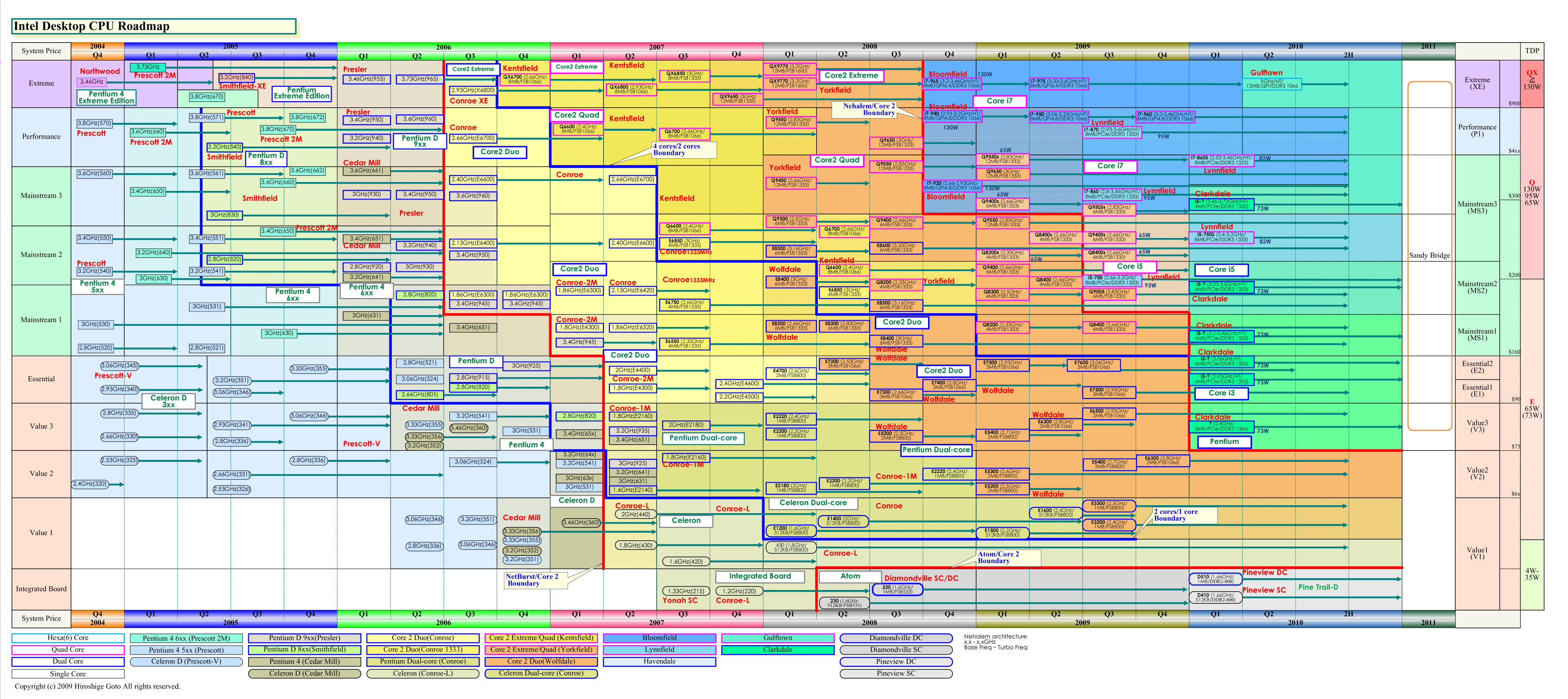
il 920 dovrebbe tirare ancora fino al 3° trimestre del 2010.
imho, acquistare un 860 ora a questi prezzi (mediamente 50€ + costoso del 920) sarebbe alquanto fuori luogo.
Poi, come dico sempre, ognuno fa del proprio denaro l'uso che più ne vuole
Ciao! Sembra che tu sia interessato a questa conversazione, ma non hai ancora un account.
Stanco di dover scorrere gli stessi post a ogni visita? Quando registri un account, tornerai sempre esattamente dove eri rimasto e potrai scegliere di essere avvisato delle nuove risposte (tramite email o notifica push). Potrai anche salvare segnalibri e votare i post per mostrare il tuo apprezzamento agli altri membri della comunità.
Con il tuo contributo, questo post potrebbe essere ancora migliore 💗
Registrati Accedi