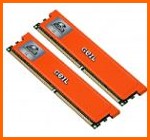
GeIL
, taiwanese brand specialized in high end solution for tweaking and overclocking fans, has announced the faster DDR2 memory kit actually avaible on the market. And we are going to test them for you!
GeIL PC2-8500 DDR2 1066 PLUS Dual Channel KitFrequenza operativa1066 MHz DDR2(Intel) 1200MHz DDR2(AMD)Timings5-5-5-15 (Intel) 4-5-5-10 (Amd)TagliSistem memory modules of 64Mx8 (512MB) DDR2-1066 CL5 SDRAM (Synchronous DRAM) component per module
1GB KIT (2x512MB) optimized forl Dual ChannelFeatures EPP SPD settings, JDEC SPD settingsRange di tensione2.4VoltsPrezzo indicativo kit da 1GB200-250 €
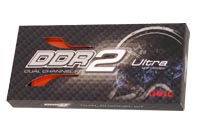
The DDR2 1066 Plus Ultra series are certificated from GeIL to operate at the 1066MHz frequency at timings 5-5-5-15 and just 2.4v. This performance are even better if we are goin to mount this kit on an AMD AM2 platform, since they can go as fast as DDR2 1200MHz with even faster timings…. CAS 4!!! GeIL infact says that this kit is certifcated to work on Asus M2N32-Deluxe SLI mainboard and Athlon 64 FX62 at 3 GHz with 10x multiplier and 300MHz fsb. This memories maintein the same stability with timings @ 4-5-5-10 but with a little more volts on them, 2.5V.
CONFIG & TEST:
| Piattaforma Intel | |
| Processore | Core 2 Duo E6400 |
| Scheda Madre | Asus P5W DH Deluxe |
| Chipset | Intel 975x |
| Ram | Geil PC2-8500 DDR2 1066 Plus Dual Channel |
| Scheda Video | Point Of View 7900 Gt GPU @ 450mhz e RAM @ 660 MHz |
| Hard Disk | HD Maxtor 120 GB SATA 8 MB buffer |
| Raffreddamento | Liquid cooled by OClabs |
| Alimentatore | Antec TruControl 1.0 550W |
| Sistema Operativo | Windows XP Professional SP2 |
| Benchmark | 3D Mark 2005 CpuBench (memory test) Sciencemark 2.0 (memory test) SiSoft Sandra 2007 |
All the Quick Benchmark test were made with 266Mhz FSB, because the MCH frequency stays at 400Mhz and it won’t change the scores with faster timings.
And for the pure Benchmarck tests we made all them trying to find the highest stability with the 32M superPi and the highest overclock with the 1M SuperPi, with all the timings we think are the best for daily use.
Let’s see what the principal timings meanings:
CAS Latency (Tcl): refers to the length of time, in clock cycles, it takes for a request sent from the memory controller to read a memory location and send it to the module's output pins. Lower values means higher performance. Obviously a Cas 3 implies different performance if the memory works at 166MHz or 200MHz! RAS to CAS Delay (Trcd): the dates in the memories moduleds are disposed and read in raw and column, starting from the firsts lines and then from the columns. The TRCD means the delay in clock cycles between the RAS signal and the CAS one. Lower values means higher performances. RAS Pre-charge Time (Trp): this value refers to the length of time, in clock cycles, between a RAS command the the next one. In this length of time the condensators of the memories are pre-charged. This operation is indispensable for the DRAM characteristic we told before. Obviously lower values means higher performances.Cycle Time (Tras): refers to the length of time, in clock cycles, it takes to capture the date from the memory and making it avaible for the output. Lower values means higher performance.
All the timings were set up by
CAS-TRCD-TRP-TRAS.